The second thing I promised in 2024 was “empirical investigations on cognitive dissonance-aware incremental update of knowledge inside LLMs”. This led to two papers: the first one shows the problem, and the second one shows that episodic context is a possible solution.
1. In praise of stubbornness (2025)
Joint work with Simone Clemente and co-authors.
An LLM blindly believes its training data even if it contradicts its prior knowledge, while a human detects when something contradicts their prior beliefs. When such cognitive dissonance occurs, the human actively engages in resolving it.
We therefore studied a simple question: what happens inside an LLM when we update it with facts that are new to it, and what happens when we update it with facts that contradict what it already knows?
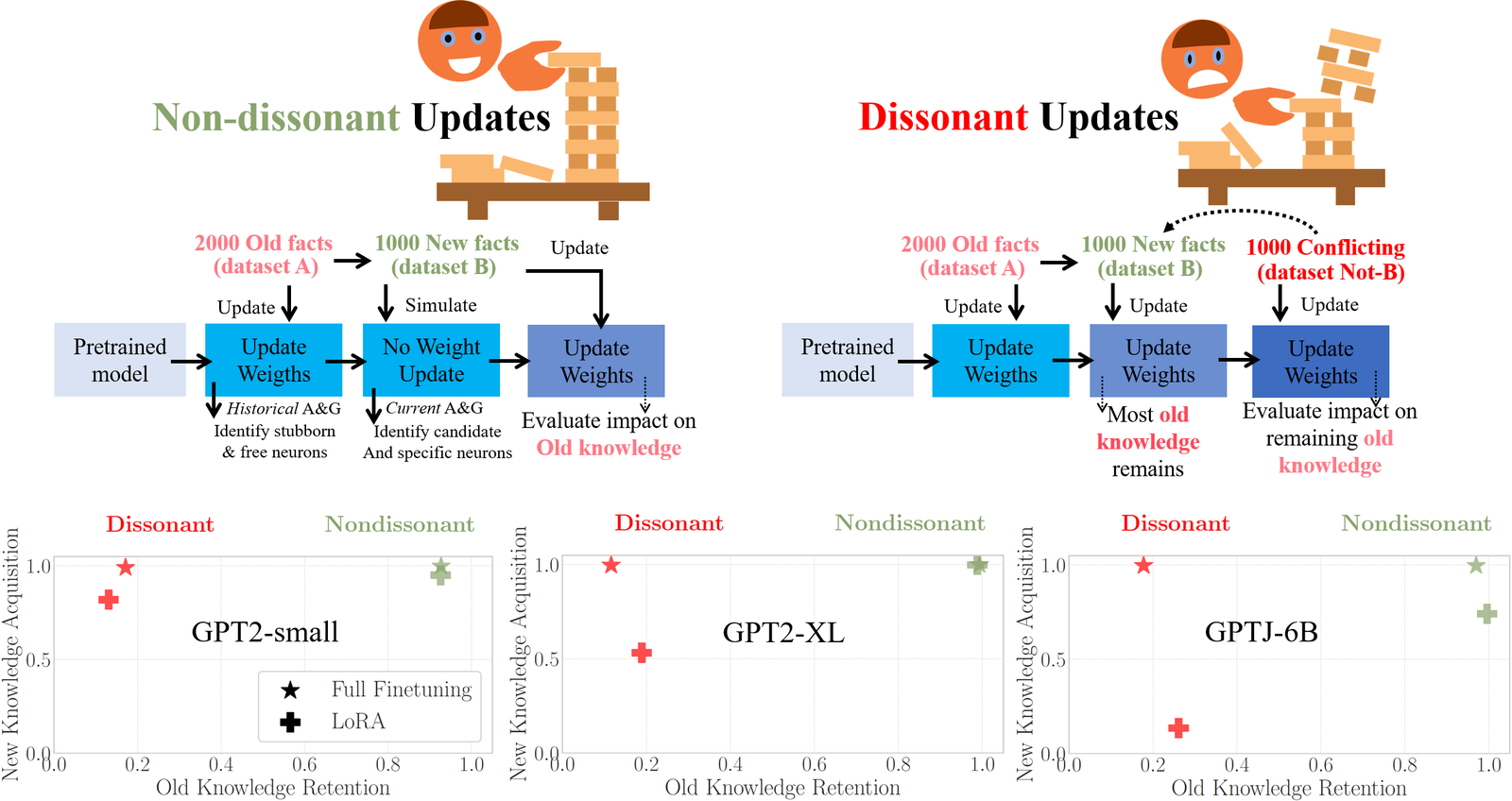
Adding new facts is like adding blocks to the tower. Adding conflicting facts makes the tower fall. Bottom: old knowledge retention (x axis) after non-dissonant (green) and dissonant (red) updates, for three models.
What we found:
- Dissonant updates are catastrophic. Dissonant updates destroy prior, unrelated knowledge, unlike non-dissonant ones which are relatively harmless: up to 80% of the unrelated knowledge is destroyed, even when learning as few as 10 to 100 contradicting facts. In other words, the model does not only lose the contradicted fact, but also facts that have nothing to do with it.
- Stubborn and plastic neurons. We distinguished the neurons that were used a lot in the past (the stubborn ones) from the rarely used ones (the plastic ones). For non-dissonant facts, sparing the stubborn neurons improves the retention of old knowledge. For dissonant facts, interestingly, this does not help: the destruction happens whatever the neurons we update (stubborn or plastic).
- An LLM can be made aware of the conflict. Going beyond the classic novel/familiar split, we classify information as novel, familiar, or dissonant. This can be done reliably using simple features: the activations and the gradients of the model.
Just as humans rely on cognitive dissonance and stubbornness to protect valuable knowledge while learning new information, LLMs could gain from adopting similar mechanisms to safely ingest knowledge continuously. These initial findings called for methods where knowledge isn’t erased but rather transformed and contextualized, just as humans retained their old knowledge when learning that Pluto isn’t a planet.
- Clemente, Simone*, Ben Houidi, Zied*♰, Huet, Alexis, Rossi, Dario, Franzese, Giulio, & Michiardi, Pietro. (2025). “In Praise of Stubbornness: The Case for Cognitive-Dissonance-Aware Knowledge Updates in LLMs”. arXiv:2502.04390. * Equal contribution. ♰ Principal investigator. Code: github.com/bendiogene/ConflictAwareLLM
2. Surprise, episodic context and forgetting (NeurIPS 2026)
Joint work with Alexis Huet and co-authors.
But how to “transform and contextualize” knowledge? To answer this question, I looked at how animals do it.
2.1. Animals learn without forgetting
The classic experiment: fear conditioning (animated, it restarts after the last step).
A mouse is placed in a box: context A. It hears a tone, then gets a mild shock. The mouse freezes. Soon the tone alone is enough to induce freezing (fear): it has learned to map the tone to fear. Then a different box, context B. The same tone comes, but no shock. At first, the mouse still freezes. But trial after trial, the freezing stops. It looks like forgetting. But if we put the mouse back in context A and play the tone alone, it freezes again.
It did not forget. The fear memory persisted: it is tied to context A.
According to latent cause theory, a well-established account of this experiment, animals do this with two signals: (i) surprise (is this what I expected?) and (ii) episodic context (where and when am I?). Together they decide whether the animal modifies an old memory, or forms a totally disjoint new one. With a large surprise, a new trace is formed next to the old one, and episodic context then decides which trace is recalled. The two traces coexist: this looks like learning without forgetting.
2.2. Can an LLM learn without forgetting, like the mouse?
Inspired by animals and latent cause theory, we ran a parallel experiment on LLMs. The model already knows a fact: the mother tongue of Danielle Darrieux is French. Then we fine-tune it on a surprising update (her mother tongue is English), and we measure the forgetting of the old fact, and of totally unrelated facts, as a proxy for catastrophic forgetting (the details are in the paper, but we measured not only facts but also ethics and coding knowledge).
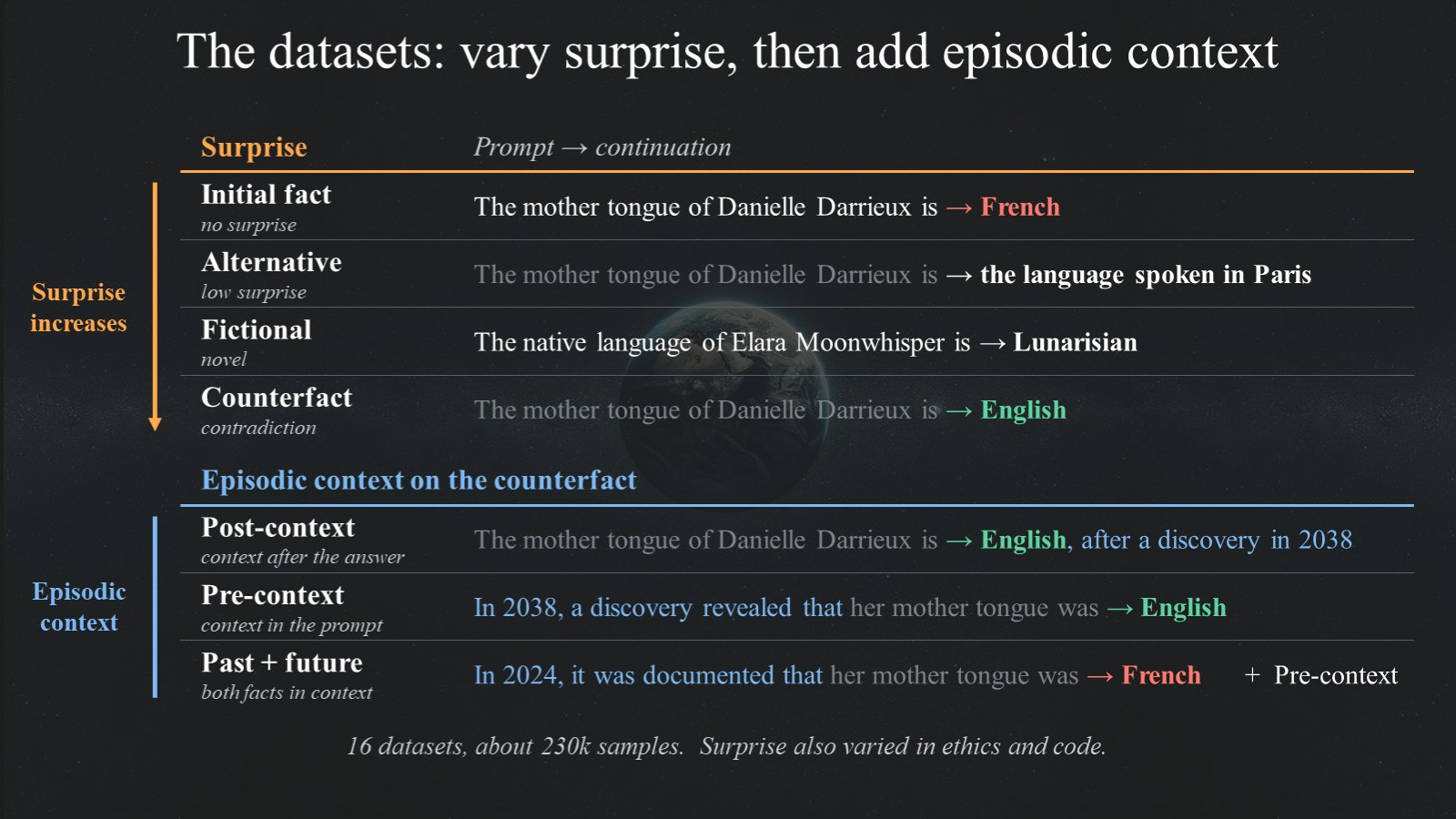
The datasets: we vary surprise, then we add episodic context to the most surprising case.
Two hypotheses guided our design:
- Surprise drives forgetting: without context, the larger the surprise, the more the model forgets.
- Episodic context protects: with episodic context, the old and the new fact coexist as two traces.
2.3. Result 1: forgetting grows with surprise
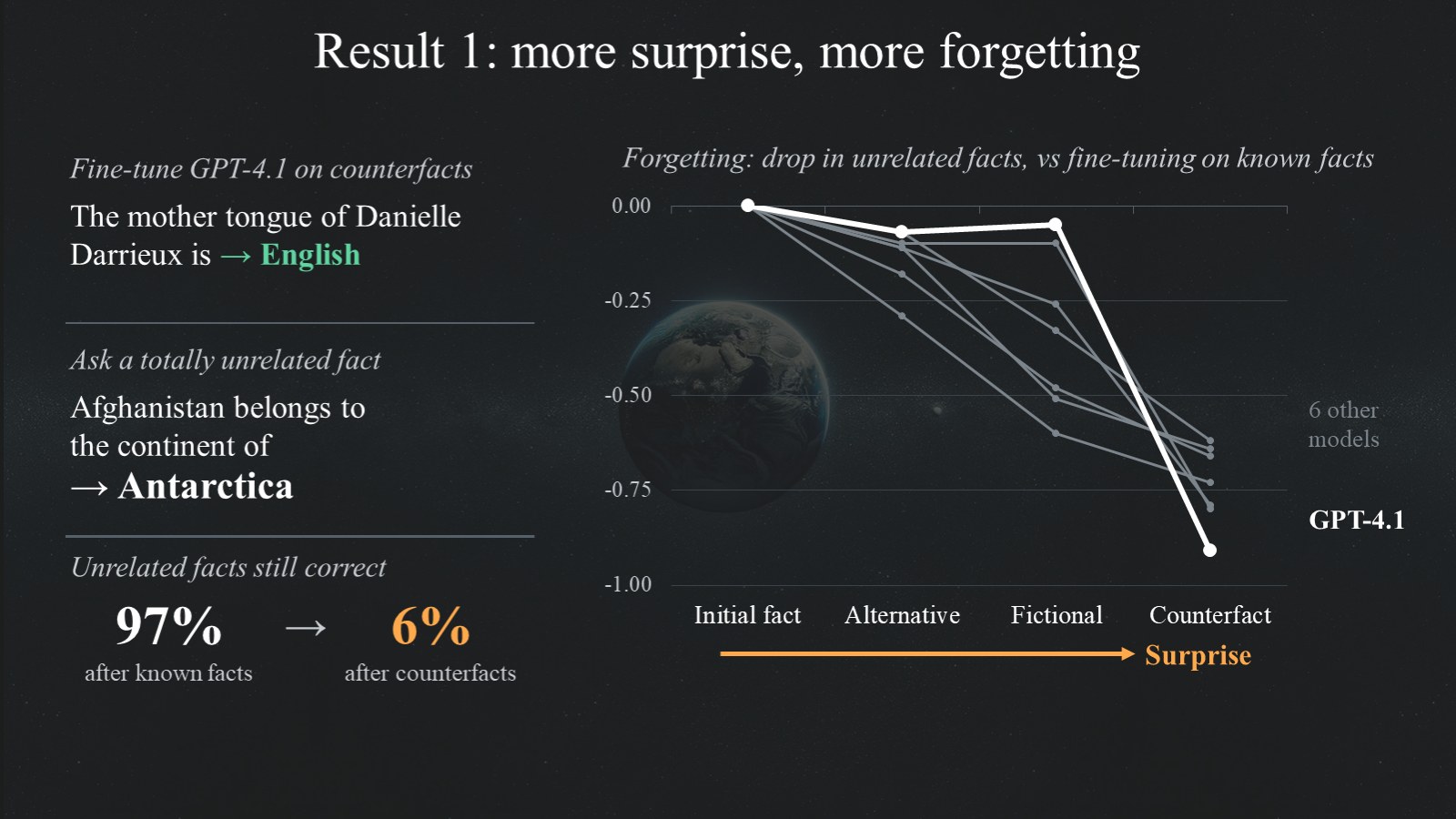
We fine-tune GPT-4.1 on counterfacts (facts that contradict what it knows, i.e. the dissonant facts of the previous paper). Then we ask about a totally unrelated fact: “Afghanistan belongs to the continent of”, and the model answers “Antarctica”! Unrelated facts are still correct most of the time after fine-tuning on known facts, but not after counterfacts: GPT-4.1-mini, for example, falls from 93% to 13%, close to a collapse of its factual knowledge. Across the seven model configurations that we tested, forgetting grows with surprise: the counterfact is always the most damaging.
2.4. Result 2: episodic context protects
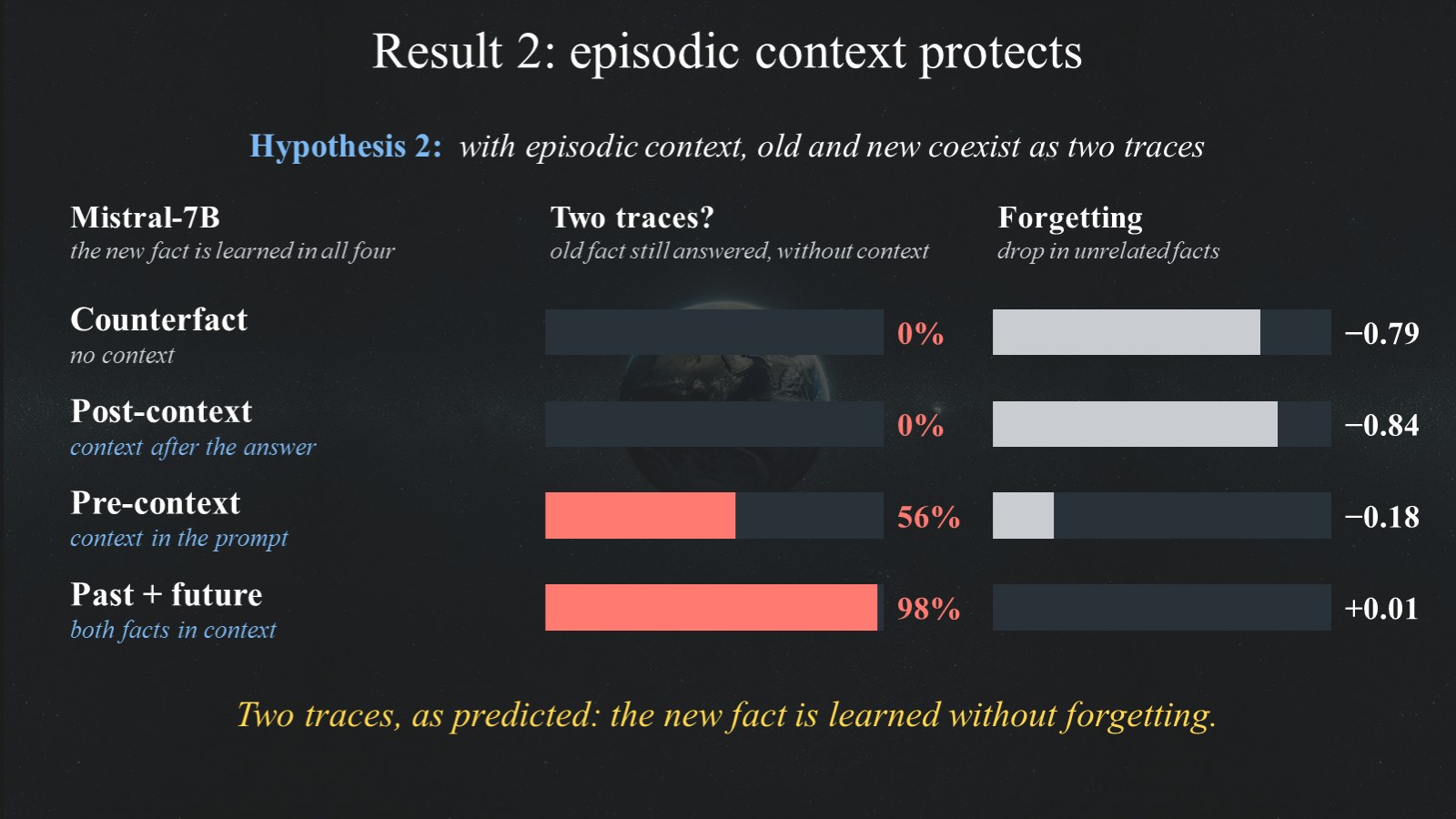
Now we give a time and an event to the counterfact, before fine-tuning the model (here Mistral) on it. We measure two things: whether the old fact (French) is still answered when we ask with no context, and how much the accuracy on unrelated facts drops.
- Counterfact with no context (“The mother tongue of Danielle Darrieux is English”): the old fact is never answered anymore, and most of the unrelated facts are lost.
- Context after the answer (“… is English, after a discovery in 2038”): this does not help.
- Context in the prompt (“In 2038, a discovery revealed that her mother tongue was English”): the old fact is still answered more than half of the time, and the damage to unrelated facts is small.
- Both facts, each in its context (we additionally contextualize the old fact in the past: “In 2024, it was documented that her mother tongue was French”): the old fact is almost always answered and, this time, there is no collateral damage at all!
As predicted, the new fact is learned without forgetting the old one.
Lesson: to learn without forgetting, put surprising updates in episodic context, in the prompt. Remember my (perhaps bold) claim of 2024: grounding in space and time is what allows us to distinguish between what is real and what is not. Our results suggest that it is also what protects the old memories from the new ones, opening the way to learning continuously without forgetting.
- Ben Houidi, Zied*♰, Huet, Alexis*, Eusebio, Alberto, Mantovani, Francesco, & Rossi, Dario. (2026). “Surprise, Episodic Context, and Catastrophic Forgetting in LLM Fine-Tuning: An Empirical Study”. Neural Information Processing Systems NeurIPS 2026. * Equal contribution. ♰ Principal investigator.
Mouse drawings adapted from SciDraw (C. Borkar; E. Tyler and L. Kravitz), CC BY 4.0.
3. What is next
The ideas above were the seed of a new set of principles, developed with Sam Gershman, that could explain how the brain learns continuously at the neural level: Reuse-and-Append Memory. The next step is to bring these principles back into LLMs.