In 2024, I promised here “a benchmark to evaluate LLMs on their ability to recall episodic events”. This page is about that benchmark, which was accepted at ICLR 2025.
This wouldn’t have existed without the work of Alexis Huet, first co-author, with whom I had fun and pleasure working. With support from Dario Rossi.
1. The problem: how to know if an LLM has episodic memory?
My claim was that episodic memory is a key missing ability in current AI systems. But before giving a “hippocampus” to an LLM, we needed a way to generate language-based episodic events and measure whether a model has episodic memory or not. Existing benchmarks were mostly testing facts (semantic memory): what is the capital of France? Episodic memory is different: it is the memory of specific events, grounded in space and time (what happened, to whom, where and when).
2. The name: a tribute to Endel Tulving
We named it the Tulving Episodic Memory Benchmark, in honor of Endel Tulving (1927-2023), whose pioneering work on episodic memory inspired this work and fundamentally shaped our understanding of human memory systems. (To be honest, the name was not adopted: people simply call it “the episodic memory benchmark” :-))
3. How it works
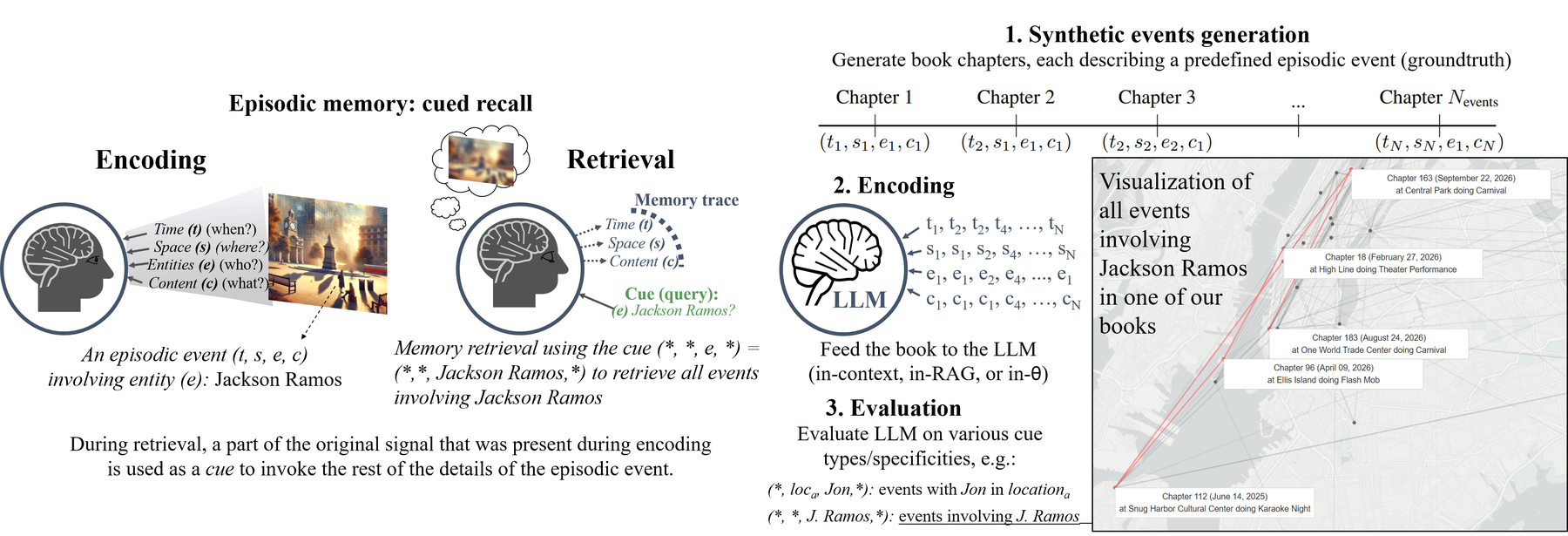
Left: episodic memory as cued recall. Right: our pipeline, from synthetic events to the evaluation of the LLM.
An event has a time, a place, an entity and a content (when, where, who and what). During retrieval, a part of the original signal that was present during encoding is used as a cue to invoke the rest of the details of the episodic event. For example: “Jackson Ramos” is the cue, and the answer is the list of all the events involving Jackson Ramos.
Step 1: we generate synthetic books. Our framework generates book-like narratives where each chapter tells one event, with its date, location, entity name and detailed content. Everything is synthetic, so the model could not have seen it before, and we know the ground truth. Events are designed to have recurring elements: in one of our books, Jackson Ramos appears in five different chapters, in five different places of New York.
Step 2: we ask questions. The model reads the book, and we then ask questions built from all the combinations of cues: what happened on this date? Where was this person last seen? List all the dates on which this person was observed. Some questions have no correct answer at all: this is how we check for confabulations.
Step 3: we compute two scores:
- Simple recall: is the model able to accurately recall the events?
- Chronological awareness: is the model able to track what happened last, and in which order?
4. What we found
When we wrote the paper, even the best models were struggling, especially when an entity appears in several events, and when the order in time matters. We kept evaluating new models after the paper was accepted, and the trend is clear: in one year, simple recall got almost solved by the best models, while chronological awareness is harder and still not solved. The ranking was updated for a while on GitHub.
However, in most of these experiments, the book is in the context window of the model (we evaluated RAG and naive fine-tuning but only briefly), which is rather a short-term episodic memory. What I wanted in 2024 was different: memories that are stored inside the weights of the model, continually, as events happen. This is the topic of the next outcomes. The synthetic episodic generation pipeline of this work was crucial for this follow-up.
Paper and code
- Huet, Alexis*, Ben Houidi, Zied*♰, & Rossi, Dario. (2025). “Episodic Memories Generation and Evaluation Benchmark for Large Language Models”. International Conference on Learning Representations ICLR 2025. arXiv:2501.13121. * Equal contribution. ♰ Principal investigator.
- Code, data and ranking: github.com/ahstat/episodic-memory-benchmark